
Description
| Pages | 648 |
|---|---|
| Publication Date | 13 January 2025 |
| ISBN | 9780197782163 (0197782167) |
| EAN | 9780197782163 |
- Offers the most extensive treatment to date of a major music-compositional technique
- Explores the topic of cadence in much greater detail than ever before
- Examines cadential closure in a wide range of musical styles
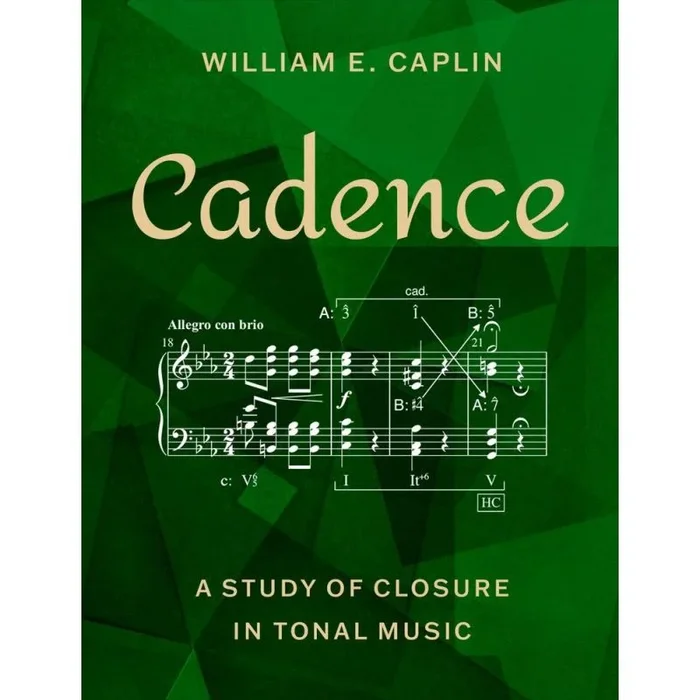
Cadence explores the many ways in which the component parts of a classical composition achieve a sense of ending. The book examines cadential practice in a wide variety of musical styles in the eighteenth and nineteenth centuries, including works by well-known composers such as Bach, Mozart, Beethoven, Schubert, Chopin, and Brahms.
Contents
- TABLE OF CONTENTS
- Preface
- Guide to the Analytical Annotations
- CHAPTER 1 IDEAS OF CLOSURE
- 1.1 Closure in Literature
- 1.2 Closure in Music
- 1.2.1 Leonard Meyer
- 1.2.2 Kofi Agawu
- 1.2.3 Robert Hatten
- 1.2.4 Patrick McCreless
- 1.2.5 Mark Anson-Cartwright
- PART 1 THE CLASSICAL CADENCE
- CHAPTER 2 GENERAL CONCEPTS OF THE CLASSICAL CADENCE
- 2.1 Traditional Notions of Cadence
- 2.2 Cadence as Formal Closure
- 2.2.1 Formal Units Closed by Cadence
- Cadence and Phrase
- 2.2.2 Cadence and Higher-Level Formal Units
- 2.3 Cadence as Harmony
- Harmony as Cadence
- 2.3.1 Progression Types
- 2.3.1.1 Prolongational Progressions
- 2.3.1.2 Sequential Progressions
- 2.3.1.3 Cadential Progressions
- 2.3.2 Ambiguity of Progression Types
- 2.4 Bass-Line Melody and Cadence
- 2.5 Cadential Arrival versus Cadential Function
- 2.6 Cadential Function versus Cadential Content
- 2.7 Limited Cadential Scope
- 2.8 Cadential Function versus Postcadential Function
- 2.8.1 Theoretical Background
- 2.8.2 Postcadential Function as Confirmation
- 2.8.3 Hepokoski and Darcy’s Critique
- 2.8.4 Two Registers of Closure
- 2.8.5 Consecutive (Repeated) PACs
- 2.9 End versus Stop
- 2.10 Cadence as Punctuation
- 2.11 Cadential Strength-Syntactical versus Rhetorical
- CHAPTER 3 BASIC CADENCE TYPES: MORPHOLOGY AND FUNCTION
- 3.1 Perfect Authentic Cadence
- 3.1.1 Morphology-Harmonic Content
- 3.1.1.1 Stages of the Cadence Schema
- 3.1.1.2 Stage 1-Initial Tonic
- 3.1.1.3 Stage 2-Pre-dominant
- 3.1.1.4 Stage 3-Dominant
- 3.1.1.5 Stage 4-Final Tonic
- 3.1.1.6 Complete versus Incomplete Cadential Progressions
- 3.1.1.7 Boundaries of the Cadential Progression
- 3.1.2 Morphology-Melodic Content
- 3.1.2.1 Basic Patterns
- 3.1.2.2 Varied Patterns
- 3.1.2.3 Combined Patterns
- 3.1.2.4 Additional Patterns
- 3.1.3 Function
- 3.1.3.1 Standard Functions of the PAC
- 3.1.3.2 Exceptional Situations
- 3.2 Imperfect Authentic Cadence
- 3.2.1 Morphology
- 3.2.1.1 Basic Tenor Stream (8/6/5/3)
- Varied (5/6/5/3)
- 3.2.1.2 Prinner Cadence
- 3.2.1.3 Other Patterns
- Melodic Diversion
- 3.2.1.4 Combined Patterns
- 3.2.1.5 Ending on 5?
- 3.2.2 Function
- 3.2.2.1 Independent IAC
- 3.2.2.2 Way-Station IAC
- 3.2.2.3 Additional Functions of the IAC
- 3.3 Half Cadence
- 3.3.1 General Conditions for Half Cadence
- 3.3.2 Morphology-Harmonic Content
- 3.3.2.1 Stage 1-Initial Tonic
- 3.3.2.2 Stage 2-Pre-dominant
- 3.3.2.3 Stage 3-Dominant
- 3.3.3 Morphology-Melodic Content
- 3.3.3.1 Simple (L-K) HC
- 3.3.3.2 Converging HC
- 3.3.3.3 Expanding HC
- 3.3.3.4 Miscellaneous Issues
- 3.3.4 Function
- 3.3.4.1 Levels of Phrase Functionality
- 3.3.4.2 Levels of Thematic Functionality
- 3.3.4.3 Some Functional Generalizations
- 3.3.5 Special Cases
- 3.3.5.1 Reinterpreted HC
- 3.3.5.2 Reopened HC
- 3.4 Additional Aspects of the Basic Cadence Types
- 3.4.1 Meter
- 3.4.1.1 A Ratio Model of Metrical Strength
- 3.4.1.2 Metrically Weaker Cadences
- 3.4.1.3 Hypermetrical Considerations
- 3.4.1.4 Metrical Weighting-Syntactical or Rhetorical?
- 3.4.2 Texture
- 3.4.2.1 Textural Types
- 3.4.2.2 Texture and Cadence
- 3.4.2.3 Covered cadence
- 3.5 Other Cadence Types
- 3.5.1 Contrapuntal Cadence
- Prolongational Closure
- 3.5.2 Plagal Cadence
- CHAPTER 4 CADENTIAL DEVIATIONS
- 4.1 Deceptive Cadence
- 4.1.1 Morphology
- 4.1.2 Function
- 4.1.2.1 Way-Station Deceptive Cadence, Replacing a PAC
- 4.1.2.2 Way-Station Deceptive Cadence, Replacing an IAC
- 4.1.2.3 Way-Station Deceptive Cadence, Denied
- 4.1.2.4 Independent Deceptive Cadence
- 4.1.2.5 Noncadential Uses of a Deceptive Cadential Progression
- 4.1.2.6 Deceptive Resolutions of the Dominant in Noncadential Contexts
- 4.1.2.7 Elided Deceptive Cadence
- 4.2 Evaded Cadence
- 4.2.1 Morphology
- 4.2.1.1 Harmonic Content
- 4.2.1.2 Melodic Content
- 4.2.2 Function
- 4.2.2.1 Way Station
- 4.2.2.2 One-More-Time Technique
- 4.2.2.3 New Material
- 4.3 Abandoned cadence
- 4.3.1 Cadential Dominant Undermined by Inversion
- 4.3.2 Cadential Dominant Replaced by Inverted Dominant
- 4.3.2.1 Replaced by Lt
- 4.3.2.2 Replaced by Le
- 4.3.3 Cadential Dominant Replaced by Nondominant Harmony
- 4.3.4 Prolongational versus Cadential
- Harmonic Expansion
- 4.3.5 Cadential Abandonment and Harmonic Reduction
- 4.4 Dominant Arrival
- 4.4.1 Arrival on a Final Dominant
- 4.4.2 Arrival on a Terminal Dominant
- 4.4.3 Premature Dominant Arrival
- 4.4.3.1 PDA on a Final Dominant
- 4.4.3.2 PDA on a Terminal Dominant
- 4.4.3.3 Hyperdominant Prolongations
- 4.4.4 Additional Issues
- 4.4.4.1 Dominant Arrival of Limited Scope
- 4.4.4.2 Reinterpreted Dominant Arrival
- 4.4.4.3 Reopened Dominant Arrival
- 4.4.4.4 Doppia PDA versus doppia HC
- 4.4.4.5 Burstein’s Critique
- 4.5 Combinations of Deviations
- 4.6 Cadential Ambiguities
- 4.6.1 Evaded versus Deceptive (Elided)
- 4.6.2 Evaded versus Authentic (Elided)
- 4.6.3 Evaded versus IAC (Elided)
- 4.6.4 Evaded versus Covered PAC
- 4.6.5 Evaded versus HC (Dominant Arrival)
- 4.6.6 Abandoned versus Deceptive
- 4.6.7 Multiple Ambiguities
- 4.6.7.1 Mozart, Piano Sonata in A Minor, K. 310, i, mm. 1-10
- 4.6.7.2 Haydn, String Quartet in D, Op. 71, no 3, iii, 1-10
- CHAPTER 5 CADENTIAL EXPANSION
- 5.1 Perfect Authentic Cadence
- 5.1.1 Harmonic Content
- 5.1.1.1 Stage 1-Initial Tonic
- 5.1.1.2 Stage 2-Pre-dominant
- 5.1.1.3 Stage 3-Dominant
- 5.1.1.4 Diversity of Harmonic Content
- Bass-Line Complexities
- 5.1.1.5 Ambiguous Onset of an ECP
- 5.1.2 Melodic Content
- 5.1.2.1 Basic Simple (3/2/2/1)
- with Cadential Six-Four (3/2/3-2/1)
- 5.1.2.2 Basic Soprano (5/4/2/1)
- with Cadential Six-Four (5/4/3-2/1)
- 5.1.2.3 Basic Alto (3/2/7/1)
- with Cadential Six-Four (3/2/1-7/1)
- 5.1.2.4 Basic Tenor (8/6/5/1)
- with Cadential Six-Four (8/6/5-4/1)
- 5.1.2.5 Varied Simple (1/2/2/1)
- with Cadential Six-Four (1/2/3-2/1)
- 5.1.2.6 Varied Soprano (3/4/2/1)
- with Cadential Six-Four (3/4/3-2/1)
- 5.1.2.7 Varied Alto (1/2/7/1)
- with Cadential Six-Four (1/2/1-7/1)
- 5.1.2.8 Varied Tenor (5/6/5/1)
- with Cadential Six-Four (5/6/5-5 (4)/1)
- 5.1.2.9 Successive Combinations
- 5.1.2.10 Simultaneous Combinations
- 5.1.2.11 Additional Patterns
- 5.2 Imperfect Authentic Cadence
- 5.3 Half Cadence
- 5.3.1 Minimum Length
- 5.3.2 Harmonic Content
- 5.3.2.1 Stage 1
- 5.3.2.2 Stage 2
- 5.3.2.3 Stage 3
- 5.3.3 Melodic content
- 5.3.3.1 Simple HC
- 5.3.3.2 Converging HC
- 5.3.3.3 Expanding HC
- 5.3.3.4 Converging/Expanding
- Expanding/Converging
- 5.4 Deviations
- 5.4.1 Minimum Size of Expansion
- 5.4.2 One-More-Time and Related Repetitions
- 5.4.3 Deceptive-Authentic Combinations (DCP-ACP)
- Melodic Content
- 5.4.4 Abandoned ECP
- 5.4.5 Dominant Arrival
- 5.5 A Cadential Conundrum
- 5.6 Expanded Cadential Progressions in Beethoven’s Symphonies
- 5.6.1 Symphony No. 1 in C, Op. 21, i, Subordinate-Theme Group
- 5.6.2 Symphony No. 2 in D, Op. 36, iv, Coda
- 5.6.3 Symphony No. 3 in E-flat (Eroica), Op. 55, i, Second Subordinate Theme
- 5.6.4 Symphony No. 5 in C Minor, Op. 67, iv, Subordinate Theme, Coda Theme
- 5.6.5 Symphony No. 6 in F (Pastoral), Op. 68, iv, Subordinate Theme
- 5.6.6 Symphony No. 7 in A, Op. 92, i, Coda Theme
- 5.6.7 Symphony No. 9 in D Minor (Choral), Op. 125, i, Main Theme
- 5.6.8 Symphony No. 9 in D Minor (Choral), Op. 125, i, Coda
- PART 2 CADENCE IN OTHER TONAL STYLES
- CHAPTER 6 CADENCE IN THE HIGH BAROQUE
- 6.1 Authentic Cadence
- 6.1.1 Perfect Authentic Cadence
- 6.1.2 Harmonic Content
- 6.1.3 Imperfect Authentic Cadence
- 6.1.4 Cadential Deviations (Authentic Cadence)
- 6.1.4.1 Deceptive Cadence
- 6.1.4.2 Evaded Cadence
- 6.1.4.3 Abandoned Cadence
- 6.1.5 Cadential Extension and Expansion
- 6.1.5.1 Consecutive PACs
- 6.1.5.2 Expansion via Slower Tempo
- Hemiola
- Change of Tempo Marking
- 6.1.5.3 Expanded Cadential Progression
- 6.1.5.4 Deceptive-Authentic Combinations (DCP-ACP)
- Pulcinella
- 6.2 Half Cadence
- 6.2.1 Harmonic, Tonal, and Formal Functions
- 6.2.2 Dominant Arrival
- 6.2.3 Precadential Dominant Expansion
- 6.3 Miscellaneous Issues
- 6.3.1 Cadential Content versus Cadential Function
- Cadences of Limited Scope
- 6.3.2 Prolongational Closure
- 6.3.3 Plagal Cadence
- Tonic Arrival
- 6.4 Cadence in Fugue: J. S. Bach’s Well-Tempered Clavier
- 6.4.1 General Concepts and Terminology
- 6.4.2 Tonal Functions of Cadence in Fugue
- 6.4.3 Formal Functions of Cadence in Fugue
- 6.4.4 Subject-Ending Cadences
- 6.4.5 Expositions Concluding with an S-Ending Cadence
- 6.4.6 Final Cadence as S-Ending
- 6.4.7 Cadential Deviations and Cadential Blurring
- 6.4.8 Three Case Studies
- 6.4.8.1 Fugue in D, WTC 1
- 6.4.8.2 Fugue in E-flat, WTC 1
- 6.4.8.3 Fugue in G-sharp Minor, WTC 1
- CHAPTER 7 CADENCE IN THE GALANT ERA
- 7.1 Morphology of the Galant Cadence
- 7.1.1 Gjerdingen’s Galant Clausulae
- 7.1.2 Prinner Cadence
- 7.1.3 Miscellaneous Variants
- 7.1.4 Melodic Overhang
- 7.2 Cadential Deviations
- 7.2.1 Evaded Cadence
- 7.2.2 Deceptive Cadence
- 7.2.3 Abandoned Cadence
- 7.2.4 Dominant Arrival
- 7.3 Extension and Expansion Techniques
- 7.3.1 Consecutive Cadences and Codettas
- 7.3.2 Expanded Cadential Progression
- 7.3.3 Pulcinella
- 7.3.4 Dominant Expansions-Penultimate, Ultimate, Precadential
- 7.3.4.1 Expanded Penultimate Dominant
- 7.3.4.2 Internal HC (or Dominant Arrival)
- 7.3.4.3 Precadential Dominant Expansion
- 7.4 Galant Cadence in Relation to Formal Functions
- 7.4.1 Main Theme
- 7.4.2 Transition
- Fusion Processes
- 7.4.3 Subordinate Theme
- Cadential Play
- 7.4.4 Development
- 7.4.5 Recapitulation
- CHAPTER 8 CADENCE IN THE ROMANTIC ERA
- 8.1 Chromaticism and Dissonance
- 8.2 Root-Position Harmonies
- 8.3 Uniform Harmonic Rhythm and Density
- 8.4 Off-Tonic Openings
- ECP Openings
- 8.5 Formal Circularity
- 8.6 Symmetrical Grouping Structures
- 8.7 Sequence versus Cadence
- 8.8 Prolongational Closure
- 8.9 Lack of Formal Closure
- 8.10 Cadential Deviations
- 8.10.1 Deceptive Cadence
- 8.10.1.1 Mondnacht
- 8.10.1.2 Waldesgesprach
- 8.10.2 Evaded Cadence
- 8.10.3 Dominant Arrival
- 8.11 Ultimate versus Penultimate Dominants
- Dissipated Cadence
- 8.12 Prinner Cadence
- 8.13 Analytical Notes to Chopin’s Preludes, Op. 28
- 8.13.1 Prelude No. 1 in C
- 8.13.2 Prelude No. 2 in A Minor
- 8.13.3 Prelude No. 3 in G
- 8.13.4 Prelude No. 4 in E Minor
- 8.13.5 Prelude No. 5 in D
- 8.13.6 Prelude No. 6 in B Minor
- 8.13.7 Prelude No. 7 in A
- 8.13.8 Prelude No. 8 in F-sharp Minor
- 8.13.9 Prelude No. 9 in E
- 8.13.10 Prelude No. 10 in C-sharp Minor
- 8.13.11 Prelude No. 11 in B
- 8.13.12 Prelude No. 12 in G-sharp Minor
- 8.13.13 Prelude No. 13 in F-sharp
- 8.13.14 Prelude No. 14 in E-flat Minor
- 8.13.15 Prelude No. 15 in D-flat
- 8.13.16 Prelude No. 16 in B-flat Minor
- 8.13.17 Prelude No. 17 in A-flat
- 8.13.18 Prelude No. 18 in F Minor
- 8.13.19 Prelude No. 19 in E-flat
- 8.13.20 Prelude No. 20 in C Minor
- 8.13.21 Prelude No. 21 in B-flat
- 8.13.22 Prelude No. 22 in G Minor
- 8.13.23 Prelude No. 23 in F
- 8.13.24 Prelude No. 24 in D Minor
- CHAPTER 9 CADENCE IN THE MID TO LATE NINETEENTH CENTURY
- 9.1 Tonic Arrival
- 9.2 Pre-dominant Arrival
- Subdominant Arrival
- 9.3 Plagal Cadence/Plagal Closure
- 9.3.1 Theoretical Speculations
- 9.3.1.1 Plagal Cadential Progression (PCP)
- 9.3.1.2 Plagal Cadential Progressions: Moment-to-Moment Listening Contexts
- 9.3.1.3 Plagal Cadence
- Prolongational Closure
- Plagal Closure
- 9.3.2 Analyses of Plagal Closure
- 9.3.2.1 Dependent Plagal Closure
- 9.3.2.2 Independent Plagal Closure
- 9.3.3 Plagal Closure versus Plagal Codetta
- 9.3.4 Additional Characteristics of Plagal Closure
- 9.3.4.1 6-5 Melodic Closure
- 9.3.4.2 Phrygian Modality
- 9.3.4.3 Home-Key Plagal Closure versus KL: HC.
- 9.3.4.4 Subdominant with Added Sixth
- 1-2-3
- 9.3.4.5 Diminished Plagal Closure
- 9.3.5 Feigned Plagal Closure
- 9.4 Prolongational Closure
- 9.5 Detour Cadence
- 9.6 Iconic Cadence
- 9.7 Cadential Deviations
- 9.7.1 A Deceptive Half Cadence?
- 9.7.2 Evaded Cadence
- 9.8 Cadential Ambiguities
- 9.9 Four Case Studies
- 9.9.1 Grieg, String Quartet in G Minor, Op. 27, Finale
- 9.9.2 Dvorak, Symphony No. 7 in D Minor, Second Movement
- 9.9.3 Liszt, Sonata in B Minor
- 9.9.4 Wagner, Prelude to Tristan und Isolde
- Glossary of Terms
- Bibliography
- Index of Musical Compositions
- General Index
Reviews
There are no reviews yet.